It’s a Tuesday night in November. The wind has been building all evening. Then you hear a pop down the street, and everything goes black.
No heat. No Wi-Fi. Your phone is at 12%. The fridge goes quiet, and you start doing math on how long the food in there will last.
And nobody can tell you when the power is coming back.
If you live around Seattle, you don’t have to imagine this. In November 2024, a bomb cyclone tore through western Washington and knocked out power to more than half a million Puget Sound Energy customers. PSE warned people to expect a multiple-day outage and make other plans.
Five days later, about 21,800 customers were still in the dark. One Auburn family went six days without power.
That’s what “a week without power” looks like. Not a doomsday movie. A bad windstorm and some downed lines.
A man should be ready for that. Not because the world is ending, but because taking care of your people is the job.
Why Renters Get Left Out of Prepper Advice
Most backup power advice assumes you own the house. Install a standby generator. Get an electrician to wire in a transfer switch. Bolt solar panels to the roof.
If you rent, you can’t do any of that. Your landlord isn’t going to let you cut into the electrical panel, and you’re not putting panels on a roof you don’t own.
So a lot of renters just shrug and buy more flashlights.
Here’s the good news: you don’t need to modify anything.
A portable power station is a big rechargeable battery with regular outlets on the front. You charge it from the wall now, and when the grid goes down, you plug your stuff into it. No wiring. No permission slip. It moves with you when your lease is up.
Why Not Just Buy a Gas Generator?
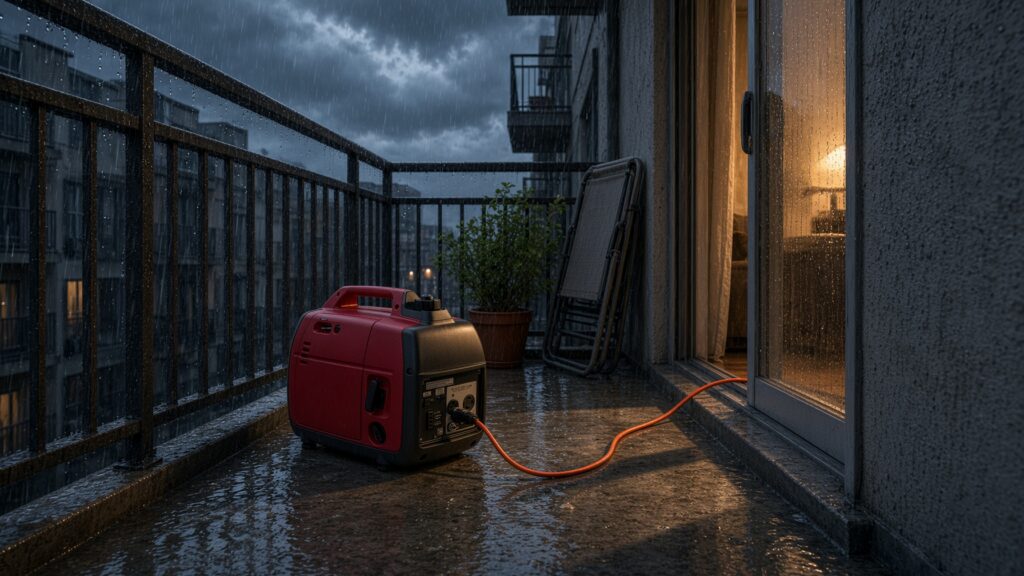
Because for a renter, a gas generator causes more problems than it solves.
1. It can kill you. Generator exhaust is loaded with carbon monoxide, and you can’t see it or smell it. The Consumer Product Safety Commission says about 100 people die in the U.S. every year from carbon monoxide from portable generators. It warns never to run one inside a home or garage, even with the doors and windows open.
Now think about your apartment. Where exactly would you run it? On a balcony right outside the sliding door? In a carport under your neighbor’s bedroom? Most rentals simply don’t have a safe spot.
2. It’s loud, and loud makes you a target. A running generator announces to the whole block that you have power. In a long outage, that’s the last thing you want. Generators get stolen right off patios. And even if nobody takes it, you just told everyone nearby that you’re the guy who’s prepared.
3. You have to store the fuel. A generator is useless without gas, and gas is a pain for a renter. Fire codes usually limit how much gasoline a household can store to about 25 gallons, in approved containers of five gallons or less each. Apartment buildings, condos, and HOAs often have stricter rules.
Gas also goes bad. Ethanol-blended gas may only last about three months. A fuel stabilizer can stretch it past a year, but you’re still keeping cans of gasoline in a closet or on a balcony and rotating them forever.
A battery power station skips all of that. No fumes. No noise. No fuel. It sits inside, behind a locked door, and nobody outside knows you have it.
Do Your Power Math First
Before you buy anything, figure out what you actually need to keep running. This is where most people overspend or underbuy.
Here’s a rough guide for a household of one to four people. The numbers for phones, lights, and the router are typical estimates, so check your own devices.
| Level | What you’re powering | Per day | For a full week |
|---|---|---|---|
| 1. Lights and phones | Phones for everyone, plus 2 to 4 LED bulbs for a few hours each night | About 110 to 260 Wh | About 0.8 to 1.8 kWh |
| 2. Stay connected | Level 1, plus the modem and router running all day, plus a laptop | About 0.5 to 0.8 kWh | About 3.5 to 5.5 kWh |
| 3. Save the food | Level 2, plus a full-size fridge | About 1.5 to 3 kWh | About 10 to 20 kWh |
One more thing nobody tells you: you don’t get to use the full number on the box. Power is lost turning battery power into wall power, and you don’t want to drain the battery to zero. A common rule of thumb from Bluetti’s own user forum is to plan for about 90% of the battery and 85% efficiency.
Run that on a 2,048 Wh unit and you get about 1,560 Wh you can actually use.
Quick action item: grab a cheap plug-in watt meter. Plug your fridge into it for 24 hours and you’ll know exactly what it uses. No guessing.
The Fridge Problem, Honestly
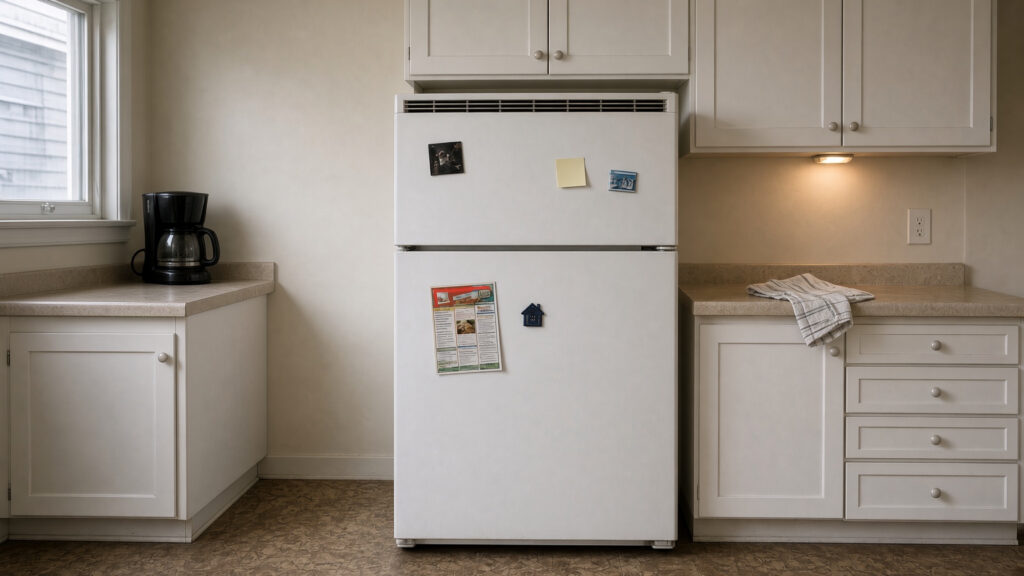
Here’s where I’m going to be straight with you. Phones and lights for a week are cheap and easy. A full-size fridge for a week is not.
Look at the numbers. Even ENERGY STAR’s most efficient top-freezer fridges, around 18 cubic feet, are rated at roughly 362 to 454 kWh a year. That’s about 1.0 to 1.25 kWh every single day. A bigger 25 cubic foot fridge is rated around 617 kWh a year, which is about 1.7 kWh a day. And the older, cheaper fridges a lot of landlords install can run closer to 2 kWh a day.
Bluetti’s own numbers for its 2 kWh FridgePower back this up. They show about 20 hours of runtime on a fridge that uses 2 kWh a day.
So here’s the rule: plan on about one day of fridge for every 2 kWh of battery. If your fridge is small and efficient, you might stretch that to a day and a half. Don’t count on it.
Find your fridge’s real number. Look for the yellow EnergyGuide label, or look up the model number online. It lists the yearly kWh. Divide by 365 and you have your daily number.
So keeping a full-size fridge alive for a week takes a big battery plus a way to recharge it. More on recharging below.
The other half of the fridge problem is you. Here’s what the USDA says: a fridge keeps food safe for up to 4 hours if the door stays closed. A full freezer holds for about 48 hours, and a half-full one for about 24.
Read that again: if the door stays closed.
Think about how many times your household opens the fridge on a normal day. Grabbing a drink. Staring inside looking for a snack. Putting the milk back. Every one of those openings dumps cold air, and the battery has to pay to cool it back down.
Quick Tips: Fridge Discipline During an Outage
- Know what you want before you open the door. No standing there browsing.
- Pull out a whole meal at once, not one item at a time.
- Make one person the fridge boss. Everyone else asks them.
- Eat the fridge food first. Save the freezer for later, since it holds cold longer.
- Keep the freezer shut. It’s your longest-lasting food supply.
The Best Power Stations for Renters
I’m an affiliate for EcoFlow, Jackery, and Bluetti, so I looked at the current lineups from all three and picked the models that make sense for renters. That means I paid attention to things the big review sites skip: weight, carrying it up stairs, fitting it in a closet, and running it safely indoors.
One feature to look for: UPS mode. You plug your fridge or router into the power station, and the station into the wall. When the grid drops, it switches over on its own in milliseconds. You don’t even have to be home.
Level 1: Lights and Phones
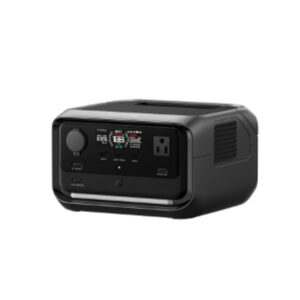
EcoFlow River 3 Plus
286 Wh, 600W output, and only 10.4 pounds. It takes up to 220W of solar input, and it expands up to 858 Wh with EcoFlow’s stackable extra batteries. That expansion is the key. By itself it won’t carry four people through a week, but with an extra battery or a solar panel it’s a solid starter setup.
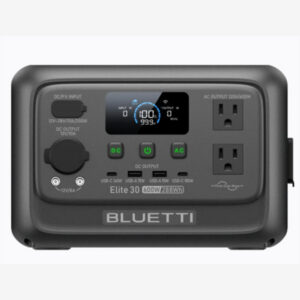
Bluetti Elite 30 V2
288 Wh, 600W output, 9.4 pounds. The cheapest way to get real backup power in the house. Great for a single guy or as a second unit for the bedroom.
Level 2: The Sweet Spot for Most Renters
If you only buy one unit, buy one of these. About 1,000 Wh covers lights, phones, and Wi-Fi for days, and it’s still light enough to carry.
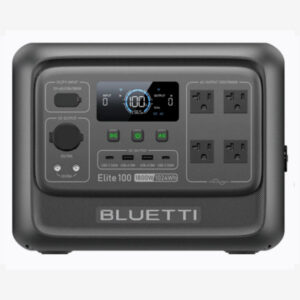
Bluetti Elite 100 V2
1,024 Wh, 1,800W output, about 25 pounds. Best value in this size right now.
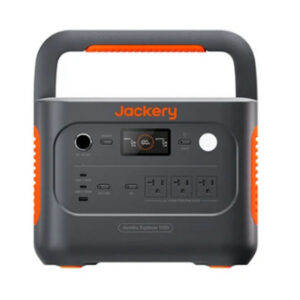
Jackery Explorer 1000 v2
1,070 Wh, 1,500W continuous output, about 24 pounds. Jackery backs it with a 3-year warranty plus 2 more years when you register it. This is the pick for the guy who doesn’t want to mess with an app. Plug it in and go.
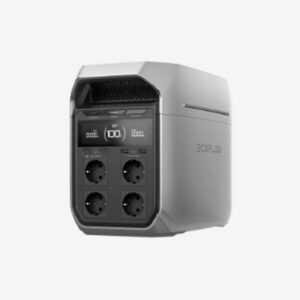
EcoFlow Delta 3 Plus
1,024 Wh, 1,800W output. Its big advantage is that it grows with you. It expands up to 5 kWh with extra batteries, so you can start here and add capacity later.
Level 3: Save the Food (Whole-House Class)
If keeping the fridge cold for days is the goal, a 2 kWh unit won’t cut it. You need the big boys: 3 to 4 kWh stations that can add expansion batteries. These are still portable. Nothing gets wired into the house. But they are heavy, so pay attention to weight and wheels if you live up a flight of stairs.
The math for a full week: a fridge plus the basics runs roughly 1.75 to 2.5 kWh a day. For seven days with no recharging, that’s about 14 to 20 kWh of battery once you account for losses. That’s a serious system. A more realistic target for most renters is 5 to 8 kWh of battery plus a way to recharge.
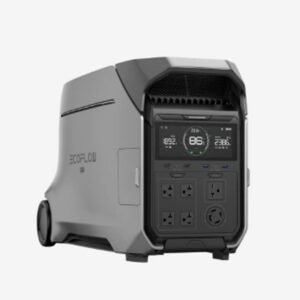
EcoFlow DELTA Pro 3
4,096 Wh with 4,000W of output. It weighs 113.5 pounds, but it has built-in wheels and a pull-out handle, so you roll it instead of carrying it. Add up to two extra batteries to reach about 12 kWh. This is the heavyweight champ of the list.
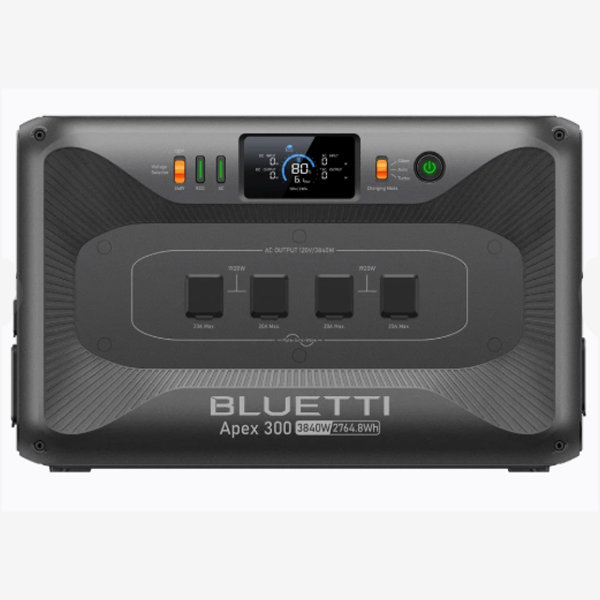
BLUETTI Apex 300
2,764.8 Wh with 3,840W of output, and about 84 pounds. Its strength is expansion: each unit takes up to six B300K batteries at 2,764.8 Wh apiece. Bluetti sells it bundled with one B300K for 5,529.6 Wh total. That bundle is a strong starting point for multi-day fridge backup. Each B300K adds about 65 pounds, but it’s a separate box you can move on its own.
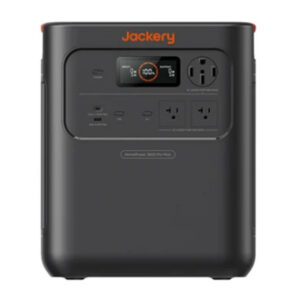
Jackery HomePower 3600 Pro Max
3,584 Wh with 4,000W of output, up to 1,200W of solar input, and expandable to 43 kWh. The catch for renters: it weighs about 70 pounds and has no wheels. Ground-floor apartments only, or bring a buddy.
EcoFlow DELTA 3 Ultra Plus
3,072 Wh, 3,600W output, and 1,600W of solar input, at 74.3 pounds. It expands from 3 up to 11 kWh. The lighter way into the whole-house class.
Recharging When the Grid Is Down
A battery is only a week of power if you can refill it. Here are your real options, and the honest truth about each one.
Folding solar panels. This is the renter’s solar setup. Set a panel on the balcony or in a sunny window, run the cable inside, and you’re charging. No roof required.
But I’m not going to lie to you. Here in the Pacific Northwest, winter sun is weak and the days are short. In a November windstorm, solar will help, but it won’t carry you. Think of it as a bonus, not the plan.
Your car: last resort only. You’ll see people recommend charging your power station from the car. You can do it, but it’s a terrible deal. An idling passenger car burns roughly 0.16 to 0.39 gallons of gas an hour depending on engine size, and turning that gas into battery power through the car’s charging system wastes most of it.
Save the gas. If a storm gets bad enough that you need to leave, a full tank is worth a lot more than a full power bank. And never, ever run the car in a garage.
Charging somewhere else. Some people plan to top off at a shelter, a store, or a warming center that still has power. That’s risky. A power station is expensive, portable, and exactly what everyone in that room wishes they had. If you go this route, don’t plug it in and walk away. Stay with it.
A Reality Check
No battery on this list will heat your apartment. Space heaters pull too much power to run for long.
So plan for the cold the old-fashioned way. Layers. Sleeping bags. Everyone in one room with the door shut.
A power station isn’t a replacement for the grid. It’s what keeps you connected, keeps the lights on, and keeps your food from going in the trash. That’s plenty.
Your 7-Day Renter Power Plan
- Do the math. Use the table above to decide if you’re Level 1, 2, or 3.
- Measure your fridge. A plug-in watt meter for 24 hours tells you exactly what you need.
- Buy the right size station. Most renters should start at about 1,000 Wh. If saving the fridge matters, go to the whole-house class and plan for expansion batteries.
- Keep it charged. Leave it plugged in, ideally in UPS mode. A dead battery in a closet does nothing for you.
- Add a recharge plan. A folding solar panel is the renter-friendly option. Keep the car’s gas for leaving.
- Set the house rules. Fridge boss, freezer shut, everyone in one warm room.
- Cover your other basics. Power is one piece. Water is another, so read my guide on filtering your tap water.
Frequently Asked Questions
Can a portable power station run a refrigerator?
Yes, but not for long without recharging. A full-size fridge uses anywhere from about 1 to 2 kWh a day, depending on its size and age. Plan on about one day of fridge for every 2 kWh of battery. To keep it going for a week, you need a bigger battery and a way to recharge it.
Is it safe to use a power station indoors?
Yes. Battery power stations don’t burn fuel, so they don’t give off carbon monoxide or fumes. That’s the big difference from a gas generator, which should never run inside a home or garage, even with the doors and windows open. Follow the manufacturer’s directions and give the unit room to breathe.
Do I need my landlord’s permission to use a power station?
Usually not. A portable power station plugs into a regular outlet like any appliance, and you don’t modify the home’s wiring. That’s what makes it the renter’s choice over a transfer switch or a wired-in generator. If you’re adding something mounted, like wall brackets, check your lease first.
How big a power station do I need for a week without power?
It depends on what you’re keeping alive. Phones and a few LED lights for one to four people need roughly 0.8 to 1.8 kWh for a week. Add Wi-Fi and a laptop and you’re closer to 3.5 to 5.5 kWh. Add a full-size fridge and it jumps to about 10 to 20 kWh, which means you’ll need a recharge plan, not just a battery.
Isn’t a gas generator cheaper?
Sometimes, up front. But for a renter, a generator comes with problems a battery doesn’t: carbon monoxide risk, noise that tells the neighborhood you have power, and gasoline you have to store and rotate. Fire codes often limit home gas storage, and apartment rules can be stricter. A power station runs silently indoors with no fuel.